
Life changing kids martial arts classes in Las Vegas and Henderson, NV
If you would like to see your child more physically active with improved listening skills, grades, focus and concentration look no further...
The Quiet Advantage Most Parents Overlook — And Why It Can Change the Trajectory of Your Child’s Life
Martial arts for kids isn’t about punching and kicking. That’s what most people think. And that, quite frankly, is the first mistake.
Most parents walk into a martial arts school thinking they are buying punches and kicks. What a well-taught class actually trains is rarer: a child’s body, attention, and character in the same hour.
The training builds balance, strength, coordination, and endurance so a child feels capable in their own skin. It also practices focus and self-control, because a stance, a form, and an instructor’s voice will not wait for a wandering mind. Confidence comes later, when a child is clumsy in public, returns the next class, and discovers they have improved.
Respect, discipline, and responsibility are rehearsed in the bow, the lineup, and the rule that someone else’s training suffers if you clown around. Bullies look for uncertainty, not technique, so a child who stands taller and knows how to use a voice is already harder to target. Add a tribe with rules—friends, older students helping younger ones—and you have more than a sport: you have a weekly rehearsal for becoming sturdier than they thought.
Martial arts teaches your child how to be self-disciplined
Now… this is where most parents get it backward. They think discipline is what happens when an adult scolds a child. Or nags. Or repeats the same instruction until the kid finally gives in.
That’s discipline. A good martial artist is something else entirely. A good martial artist is self-disciplined. Self-discipline is doing what needs to be done without being told.
In fact, I’d argue for an even better definition: doing what you need to do even when you don’t feel like doing it.
That difference sounds small. It isn’t. It’s one of the most valuable things your child can take home from class.
Martial arts classes gives your child real confidence
Then there’s confidence. Not the “good job!” kind. Not the kind that evaporates the second something gets difficult.
Real confidence. The kind that comes from setting a goal… and then actually hitting it. Every time your child learns a new move, they feel just a little more capable.
Every time they finish a form they couldn’t do last month, something clicks. And here’s the secret most people miss: Competence is confidence.
When your child knows that they are good at something, that belief compounds. It builds on itself. One small win makes the next one easier to believe.
That’s why we treat confidence as one of the most important benefits of martial arts training. And that’s why our martial arts classes for kids include confidence-building drills in every class. Not once in a while. Every class.
Martial arts are a fun way to give your child the exercise they need
And yes… they’ll get in shape. Strength. Flexibility. Cardio. Most parents assume those are three separate workouts. Three different programs. Three different afternoons.
In martial arts, they happen at the same time. In a single 45-minute class, your child works all three.
Take kicking. As they try to kick higher, their core fires. The higher the kick, the more those muscles have to work.
Repeat that drill enough times, and the same movement becomes a cardio workout. One movement.
Three results. That’s the point. Martial arts isn’t just something your child does after school. It’s how they learn to protect themselves, govern themselves, believe in themselves — and get stronger doing it.
Smilin' sweatin' and learnin'
SSL: Smilin’. Sweatin’. Learnin’.
Have fun. Get a workout. Leave knowing something you didn’t walk in with.
That’s the whole idea. Kids will work hard if the work feels like play. Boredom is the enemy. The fastest way to teach a child is to hide the lesson inside a game they already understand.
Take a martial arts drill and turn it into something familiar — a race, a challenge, a story, a score to beat — and the connection clicks: moving their body isn’t a chore.
It’s fun. And once it’s fun, they sweat, they smile, and they learn without noticing they’re being taught.
Kids Today Face a Different Kind of Challenge
Your child lives in a different world than the one you grew up in.
If you are a parent, you already know this truth in your bones:
Your child is growing up in a world that asks more of children than any world before it — more focus, more emotional control, more resilience, more social skill — while offering fewer natural places to practice those things.
Screens steal attention.
Schools demand performance.
Peers test confidence.
And the old neighborhood “go outside and figure it out” apprenticeship has largely vanished.
So you look for an activity. Soccer. Dance. Swimming. Music. All good. All worthy. But there is one kind of class that does something most activities never quite do.
It trains the body and the character at the same time.
It makes effort visible.
It makes progress undeniable.
It puts your child in a room where respect is not a poster on the wall — it is the price of admission.
That class is martial arts. Not the movie version. Not the cartoon kick. The real thing: a well-run children’s program. What follows is a parent’s brief on why this particular habit — two or three evenings a week on a mat — can become one of the most useful gifts you ever give your child.
Discipline That Actually Sticks
Self-discipline is the ability to do the right small thing when nobody is forcing your child — and when a more pleasant thing is sitting right there. Martial arts is one of the few children’s activities that rehearses that exact moment, twice a week, in public.
The class runs on rules your child did not write. Bow. Line up. Wait. Be silent while someone else works. Hold a stance after the legs start to shake. Repeat a movement that already feels old. None of this is natural to a child. That is the point. Your child practices placing an outside standard above a passing mood.
The instructor makes the standard visible. If your child’s hands drop, the technique fails. If your child rushes, the partner notices. There is no committee to argue with and no participation trophy to blur the result. Your child learns a clean chain: choice, action, consequence. Over time the instructor’s voice becomes an inner voice. That is the transfer parents are actually paying for — not “yes, sir” on the mat, but “I should start my homework” at home.
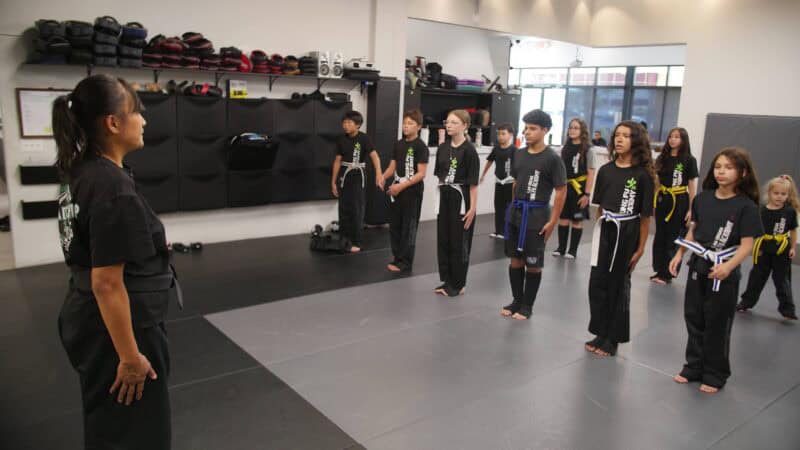
Belts and stripes tighten the lesson. The reward is delayed on purpose. Your child wants the next rank now. The school says not yet. So your child keeps training through the gap between appetite and arrival. That gap is self-discipline. Most of childhood tries to close it with entertainment. Martial arts leaves it open long enough for your child to grow a spine across it.
The habit sticks because it is physical. Your child does not merely hear that discipline matters. Your child feels what happens when discipline is present — balance, power, a movement that finally works — and what happens when it is absent. The body becomes the teacher. And a teacher the body believes is the one your child will still obey when you are not in the room.
Resilience: Learning to Get Back Up
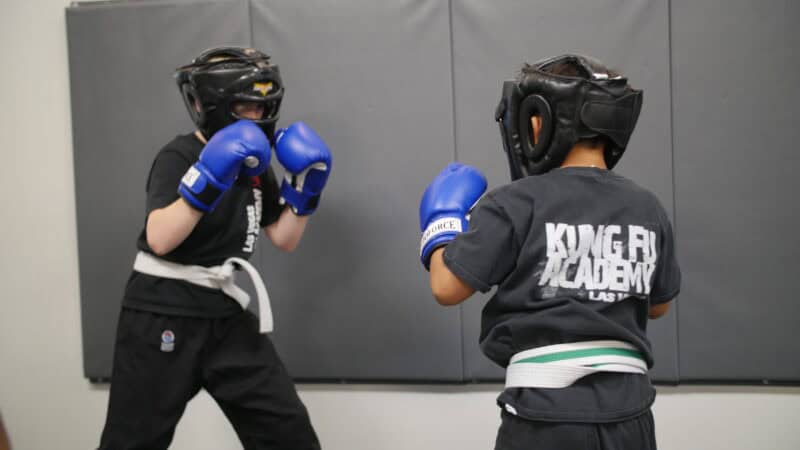
Martial arts builds resilience the same way it builds a punch: through repetition under pressure, not through slogans.
Your child walks into class able to fail in public. The kick is sloppy. The fall is awkward. Other children are watching. A lesser activity lets your child hide in the pack or wait for a turn that never quite comes. A good martial arts class makes the miss visible — and then immediately useful. The instructor does not rescue your child from the feeling. The instructor names the next action: reset the feet, breathe, try the same movement again. That tiny cycle is resilience training. Discomfort arrives, your child stays, competence grows.
The belt system does the rest. Progress is slow enough to frustrate and clear enough to believe. Your child cannot buy the next stripe with charm. Your child has to return on the nights when the couch wins the argument in every other part of life. Showing up after a bad class teaches a rarer lesson than winning a good one: a bad day is not a verdict.
Sparring and partner drills add a second layer. Another body does not cooperate. Plans collapse. Your child learns, in the body, that panic makes everything worse and that a smaller, calmer response often works. Fear stops being a stop sign and becomes information.
Then the habit travels. A hard test, a harsh comment, a team that cuts your child — the nervous system already has a script: stand up, make the next honest attempt, do not turn one failure into a story about who your child is. That is how the class helps. It does not give your child resilience as a gift. It gives your child a weekly place to practice not quitting.
Confidence That Is Earned, Not Handed Out
There is a cheap kind of confidence: participation trophies, empty praise, “you’re amazing” said so often it means nothing.
There is another kind: the confidence that comes from being bad at something difficult in front of other people — and getting less bad.
A well-run kids’ martial arts class is engineered for that second kind.
Your child steps onto the mat. Other children are watching. The instructor demonstrates a movement your child cannot yet do. Your child tries. It looks clumsy. The instructor corrects. Your child tries again. A week later it looks less clumsy. A month later your child can teach the movement to a newcomer.
That sequence is confidence in slow motion.
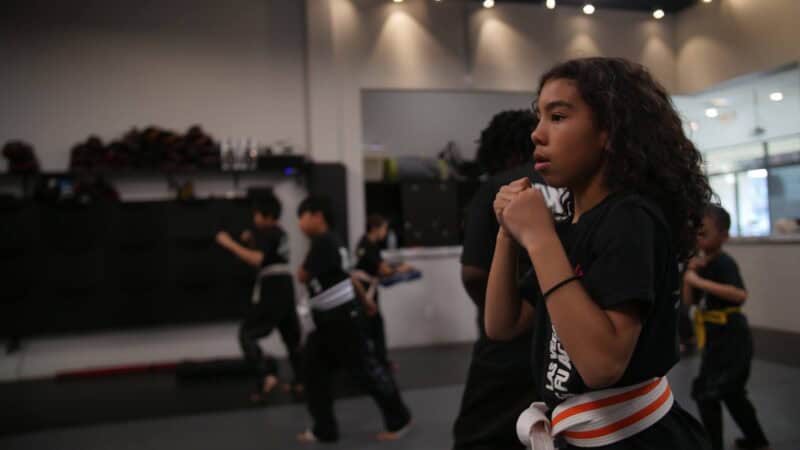
Bullies are amateur talent scouts for uncertainty. They look for the child who drops the eyes, who apologizes for existing, who will absorb unkindness to keep the peace. A child who has practiced standing still, speaking with a clear voice, and occupying space does not present the same target. That is not mysticism. That is social perception.
Good programs teach a ladder of responses, not a fantasy of movie violence: posture, voice, distance, adult help — and physical skill only if a situation becomes unsafe. The point is not to raise a fighter. The point is to raise a child who does not radiate helplessness.
Parents often report a change they can see in the parking lot. Your child walks taller. Your child answers a grown-up without hiding. Your child no longer disappears behind your leg when someone says hello.
That is not swagger. That is orientation. Your child has been given a map for how a capable person stands in the world.
Self-Defense Without the Fantasy
Real-world, practical self-defense your child can actually use: how to stand, how to create distance, how to use a clear voice, how to break contact, how to get to safety, and — only if a situation turns physical — how to protect your child with simple, reliable skills.Judo and jiu-jitsu teach your child how to fall without panic and how to control a larger body without wild striking. Karate and taekwondo teach range, timing, and boundaries. A child who has practiced those things is not as helpless as a child who has only practiced screens.
But practical self-defense begins before the first technique.
Awareness.
Voice.
The habit of telling an adult.
The refusal to be pulled away from the group.
The posture that says, “I am not invisible.”
That is the curriculum we put first, because most trouble is stopped there. The physical tools come next, taught with restraint, drilled until they are ordinary, and framed as a last resort — not a license to escalate.
If a school leads with fantasy violence, keep walking. If a school teaches confidence, discipline, and practical self-defense your child can remember under stress, you are in the right place.
The best self-defense outcome is still the one your child never has to use. The second-best is the one your child can use — calmly, simply, and well — if walking away is no longer enough.
Friends, Belonging, and Social Skills
Here is the part you may not be looking for, and the part you may end up valuing most.
Your child walks into a room of strangers. Different ages. Different personalities. Different skill levels. Within a few weeks, those strangers start to feel like people who know them.
They pair up for drills. They watch each other test. They blow a move, laugh, reset, and try again. They share the same awkward first month and the same small wins.
That does not happen by accident in our classes. Our instructors treat social skills and character as part of the training, not an extra speech at the end. They teach your child how to make eye contact, how to greet a partner, how to take turns, how to wait, how to encourage someone who is struggling, and how to win or lose without making another child feel small. Respect, kindness, self-control, and responsibility get coached in the same hour as the techniques.
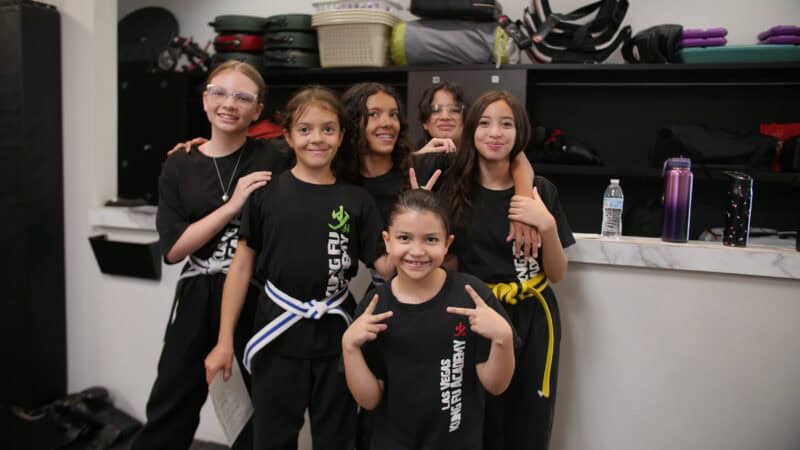
If your child is shy, this can be a relief. Nobody is asking them to work the room. They do not have to be witty. They only have to stand next to someone and do the work. Conversation starts on its own. “You go first.” “That was better.” “Want to try it again?” Our instructors help those moments happen. They pair students with care. They step in when a child freezes. They praise the quiet effort as much as the flashy technique.
If your child is loud and full of energy, the class gives that energy somewhere honest to go. They can still be themselves. They just cannot run the room. Our instructors channel that fire into focus, teamwork, and better manners, not into showing off.
And if your child has been the one sitting alone at lunch, or hovering at the edge of the playground, this may be the first place they feel they belong because of effort instead of image. Not the right shoes. Not the right game. Just showing up and doing the work. In our school, belonging is built on character: how your child treats the person next to them.
You may not notice it at first. Then one day you will hear a name in the car. Then another. Then you will see your child waiting by the door for someone. Then you will watch them walk out after class talking, laughing, standing a little easier in their own skin.
That is the social gift.
Not a crowd.
A place where your child is known, guided, and taught how to be a better teammate as well as a stronger student.
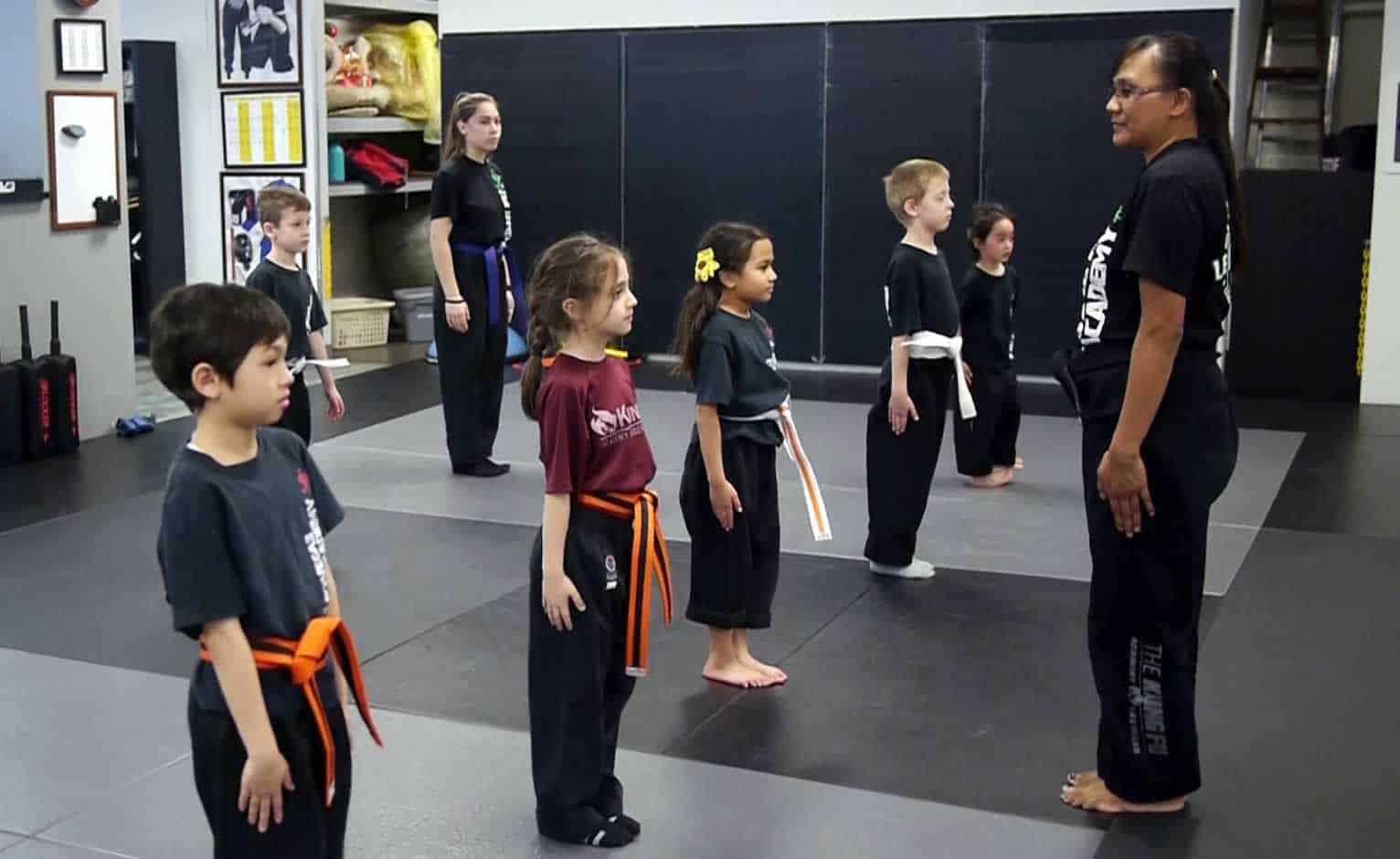
Martial arts classes for kids will teach your child how to set goals
Most high level, successful people in life will have a lot of personality traits in common with each other. One specific trait these people all have in common is the habit of setting goals for themselves. If you were to ask a pro athlete or entrepreneur what their habits are with goal setting, most will say that it's a habit they exercise weekly. Setting goals allows your child to visualize the path to accomplishment. In order to analyze your progress, your goals must be clearly defined.
You need something to compare against.
Goal-setting becomes concrete. The next belt is visible. The requirements are known. The child learns to work toward something that takes months, not minutes.In a culture that often rewards instant results, this lesson is rare and valuable.Emotional Control When It CountsFrustration is part of learning any physical skill.A kick does not snap the way the instructor showed. A form looks sloppy. A partner is better that day.Martial arts gives children a place to feel that frustration and then channel it. They learn to breathe. They learn to reset. They learn that anger does not improve technique.
Here's something you probably don't know about martial arts:
The different colored belts the students wear is really a system for goal setting disguised as part of the uniform
Let me explain...
Most people have heard of a karate black belt, right?
Actually, there are many levels to go through before someone gets promoted to a Black Belt. Each level has it's own color belt.
Each belt level has certain physical and philosophical requirements.
Your child will have to know the techniques and forms for their level in order to pass to the next colored belt.
Here's the secret... Each belt level is a really short term goal in disguise.
When kids earn their belts it gives them a great sense of genuine accomplishment and a feeling of competence that tremendously improves the way they view and feel about themselves.
Our belt system is the key to teaching self-confidence. This system makes your child feel special and unique. When they get promoted, the recognition that students receive from their peers is one of the most powerful forces of change.
Promotions in rank tremendously improve the way they view and feel about themselves. With each rank toward Black Belt, your child's martial journey becomes more and more real, and definitely more exciting.
Focus is the ability to pay attention even when it is challenging
You can tell your child to “pay attention” a thousand times.
Or you can put your child in a room where inattention has an immediate, painless consequence: the technique fails, the partner notices, the instructor asks your child to try it again.
That is a kinder teacher than nagging.
Traditional martial arts demand working memory, self-control, and the ability to switch from one task to the next without falling apart. Your child must remember a sequence, keep the hands in the right place, watch a partner, and still hear the instructor’s voice.
Notice the pairing: body and classroom. When your child learns to hold a stance for thirty seconds without collapsing, your child is also practicing the same inner posture required to finish a worksheet. Martial arts will not turn every child into a straight-A student.
Nothing honest will promise that. But if your child’s schoolwork is being eaten by restlessness, a class that trains attention in the body can be one of the most practical academic supports you can buy — without calling it tutoring.
The Paradox That Convinces Skeptics: Less Aggression, Not More
Here’s the question. You may already be thinking it.“If I put my child in a fighting class… won’t my child become more aggressive?”
Fair question. You’ve seen the movies. You’ve seen the bad gyms. You’ve seen the loud kid who treats every disagreement like a scene.
So you hesitate.
Good.
You should.
Because the benefit you actually want is not a child who looks for a fight. It is a child who can feel the heat rise — and still choose not to explode.
That is what we train.
A well-run martial arts class does not feed rage. It starves it. Your child wants to rush. We say slower. Your child wants to swing wild. We say clean. Your child wants to win ugly. We say help your partner up. Power without control is not praised here. It is corrected. And something quiet starts to happen at home.
Fewer blow-ups.
A shorter fuse that suddenly has a pause in it.
A child who can take a no without turning the room into a courtroom.
That pause is the benefit.
It is self-control you can live with. In the kitchen. In the car. On the playground. The same discipline that makes practical self-defense work — walk away, talk it down, use physical skill only if you must — is the discipline that keeps your child from becoming the problem. One caution, and I’ll give it to you straight. This does not happen in a chaotic class. It happens when the instructor is a teacher, not an entertainer. Watch a session. Watch how the smallest child is spoken to. If the room is built on respect, you will not get a more aggressive child. You will get a child who knows how to stop.
Your child will learn how to walk away from conflicts
Let me be honest with you.
Most people think self-defense starts with a punch.
It doesn’t.
The real skill — the one that keeps your child safe in the real world — is knowing what to do before a fist ever flies.
First: walk away.
That sounds simple. It isn’t. Walking away takes awareness, timing, and the confidence to leave while a bully is still performing for an audience. We teach your child that leaving is not losing. It is winning the only contest that matters.
Second: use words before force.
Your child learns how to speak with a clear voice, hold a firm posture, and shut down the situation before it grows teeth. A bully is hunting for an easy reaction. A calm, direct response is often the last thing that bully expects. And then — only then — come the physical skills. When you enroll your child in our kids’ martial arts classes, your child does not get a fantasy. Your child gets a ladder. Walk away. Talk it down. Defend if there is no other choice.
That is practical self-defense. And once your child has practiced it, the posture changes. The voice changes. The “easy target” look starts to disappear. Because a child who knows what to do next is a much harder child to bully.
Your child will learn practical, real-world self-defense that works.
But make no mistake about it,
Your child will learn practical, proven self-defense methods that work against the types of attacks that kids experience.
For example, your child will learn escapes from a headlock, front kicks and side kicks from karate, releasing from holds and grabs from jujitsu, getting up from being pushed on the ground and defenses against shoving and pushing.
However, let's face it… teaching children fighting techniques, can be dangerous IF they are not also taught responsibility in addition to self-defense techniques.
Of course, you want your child to know that self-defense is just that, defensive. Self-defense should only be used when you are in danger. You definitely do not want your child to go home and use their techniques on a sibling or classmate at school.
And did we mention that martial arts classes are fun?
Let's face it...
If martial arts training was not fun your child will not want to come here. And honestly, you as the great parent your are would really hesitate to bring them. you want something that is BOTH fun and disciplined. You are looking for a karate class that your child WANTS to come to every day. All parents want to find an activity that your child will be passionate about. For example, can you imagine what it would be like finding your child practicing in their room every day (without being told to)
This is the kind of class we want to give you and your child.
Enroll your child in martial arts classes for kids today and discover the amazing benefits they will experience for the rest of their lives!
A word of caution: not all martial arts classes are created equal. It's sad but true - there are too many schools out there that claim they can deliver what parents really want but don't quite get the job done.
You have so many choices when it comes to enrolling in a martial arts school.
Think about it...
First, you might join karate classes, kenpo classes, aikido, krav maga, and so forth.
When you enroll in a martial arts school you will be spending time, money and effort at the school. You want to make the right decision from the very beginning.
OK, I know what you're thinking...
So how are we different?
Your child will get personalized instruction
First, when you start classes at our school your child will not just be a number in the crowd, like at many other karate schools.
We are a family-oriented school and not a franchise. We know every single student's name in our entire school, and your child will soon know everyone's name as well.
All of our students know each other's names. I have been to some schools where students are working partner drills with each other and they don't even know each other's names!
Second, everyone trains in the martial arts for different reasons.
Your child will not be a nameless uniform in the back row. We teach in a way that sees the actual child in front of us — the shy one, the restless one, the child who learns with the eyes, the child who needs to feel the movement once before it sticks. In class, that means your child’s stance gets corrected, your child’s hands get placed, and your child’s effort gets noticed before the moment passes. We do not wait for your child to get lost in the group and hope it sorts itself out. We adjust the drill, slow the technique, or raise the challenge so the work fits this student, today. Personalized instruction is how practical skill is built: not a speech to the room, but a teacher’s attention on your child’s feet, timing, and confidence until the movement belongs to your child — not to the child next to them.
The truth of the matter is that the only way to get you the benefits that you are looking for is to make every class personalized for each student. But how is this possible?
Everyone learns differently
Let me show you exactly how this works:
When you come to class it is my job to find out what kind of learner your child is. Some people learn very well through verbal instructions while other students may learn from having me physically go and move their arms in the correct position.
Others may learn best from seeing some of the advanced students perform movements.
There are many teaching techniques we use in class to make sure that every single student walks away from the class with something fresh. This doesn't mean we teach something new to each class, but rather we found a way to keep things interesting.
No one sits on the bench. No child ever feels "Left out", or like he's "Letting the team down"
Team sports can be wonderful. They can also be brutal little courts of popularity.
Martial arts has a different social physics.
Your child is not competing for a starting spot that only eleven children can have. Your child is competing with yesterday’s version of your child. Belts and stripes, used wisely, mark personal progress. The classmate next to your child can earn the same rank without taking anything from your child.
Partners rotate. The shy child is paired with the confident one. The advanced student is asked to help the beginner. That is not accidental. It is how a school turns technique into community.
For a child who does not thrive in large, loud team environments, this can be the difference between “I hate sports” and “I have a place.”For a child who does thrive in teams, martial arts adds a solo spine: a practice that does not depend on nine other people’s attendance.

Team sports favor the physically gifted
Here's the real kicker, team sports like baseball and football often favor the more physically gifted while at the same time alienating kids less who are less coordinated.
The result?
Every year a new crop of kids enters into sports and again only the bigger stronger kids get picked to play while your kid sits on the bench. It's not surprising that many children grapple with issues of self-esteem and misplaced aggression.
At our martial arts academy, no child sits on the bench. Our mats always packed. Benches lie empty. Every kid that's on our team gets equal playing time.
What a Great Children’s Program Looks Like
Because the instructor is the product, here is your inspection checklist. Visit. Sit. Watch a full class, not a sales tour.
1. Safety is boring — and that is good.
Mats clean. Jewelry off. Water breaks. Sparring, if any, is controlled, matched by size, and stopped the instant sloppiness appears.
2. The instructor’s voice is firm and kind.
Not a drill sergeant performing toughness. Not a camp counselor chasing giggles. A teacher.
3. Beginners are protected.
Your child is not thrown to the wolves on day one. There is a curriculum. There is a reason for the first six weeks.
4. Character is coached out loud.
You should hear words like respect, control, patience, and encouragement — and you should see them enforced when a child forgets.
5. Progress is visible but not frantic.
Belts exist to mark work, not to extract fees. If every child is promoted on a calendar regardless of skill, the school is selling costume jewelry.
6. Parents are partners, not spectators only.
The best schools tell you how to support practice at home in two minutes, not two hours. They do not require you to become an assistant coach.
7. Trial is easy.
A good school is not afraid of a trial week. Confidence does not need a hard close. If you cannot find all seven, get as many as you can. The first four are non-negotiable.
Passionate instructors who truly care
Our instructors have high expectations and are also very clear about limits. We enforce good rules of behavior in class, and we expect the same good behavior at home and in school.
All of the instructors and helpers at our academy are PASSIONATE and Energetic.
We have been teaching for 27 years and we truly love working with children. We understand that most fun teachers are teachers who have fun themselves while teaching.
We also understand the responsibility that comes with being a martial arts instructor. Kids look up to their instructors and will make lasting memories that will stay with them for a lifetime.
You CHILD will Learn
Multiple Styles Of Martial Arts
Kung Fu
Kung fu is from China. It is the mother art to Karate. China was the first country in ancient times to develop martial arts.
As the culture was exported to Japan, many of the fighting techniques and systems became part of the Japanese culture. In Japan, Kung fu slowly became known as Karate.
Kung fu literally translates from Chinese to English as "Hard Work" It involves blocks, punches, kicks, takedowns, and joint locking as it is a complete martial arts style.
Kali / Escrima / Arnis
Kali, Arnis, And Escrima are all names for styles that come from the Philipines. These are weapon-based arts.
Kali, Arnis, And Escrima, are known for having the best strategies for dealing with knives and edged weaponry. Thus, it is one of the main arts studied by special forces around the world.
Although these Filipino martial arts are famous because of the practical weapon defenses, they do contain self-defense techniques. The empty hand curriculum is sometimes known as Panantukan or Suntukan.
Judo
Judo is one of the best arts for children. Kids in martial arts frequently learn how to punch and kick in their classes.
However, in many of the self-defense situations that your kids will face in their life, the most frequent type of attack is going to be where the bully tries to tackle them to the ground.
This is where the Japanese art of Judo comes into play. Judo is an excellent self-defense art to use against someone rushing at you.
Free practice, also known as Randori is a wrestling match between students. Both kids are trying their best to throw and not be thrown. There is both a winner and a loser. When martial arts becomes competitive, I see it as an opportunity to teach all of the life skills that martial arts are supposed to teach. For example, one of the things your child will learn is how to be mentally tough. They have to be able to get up after a fall and try again. This type of fortitude and perseverance is invaluable in today's society.
Boxing
Because Boxing is a competitive sport, there is a winner and a loser every-time you step into a ring. Boxing teaches you to win with humility and lose with grace. Everyone reacts differently to winning and losing. The right way to look at the competitive aspect of Boxing is to know that every loss is a chance to learn. It should teach you that the more you stick with it the more you start to win. Losing is motivation as well. Losing a match is some potent fuel for training harder the next time you step in to the ring.
Kick Boxing
Kickboxing gives kids something a lot of other activities don’t: a way to get stronger, sharper, and more confident while they’re having too much fun to notice they’re working.
In class, children learn how to move, punch, kick, block, and keep their balance. That sounds like fighting. What they’re really building is control. They learn to use their body on purpose instead of flailing when they get excited, scared, or angry. They learn to keep their hands up, their feet under them, and their attention on what’s happening right in front of them.
That focus carries. A child who can follow a combination, wait for a turn, and reset after a mistake is practicing the same skills they need for school, sports, and the rest of life. Kickboxing also burns off a lot of energy in a healthy way. Kids leave tired, proud, and usually in a better mood than when they walked in.
Some of the things you will learn in our kids martial arts classes are:
These are some of the concepts and drill we teach in martial arts class.
I can hear the objections.
They are reasonable.
“Won’t this make my child violent?”
That is the first fear, and it is the most backward.
People who cannot fight are often more dangerous in small ways. They panic. They escalate. They use words like weapons because they have no other sense of power. People who can fight, and who have been raised inside a code, tend to become harder to provoke. The skilled student has less to prove. A cheap hallway victory looks foolish once you know what real difficulty feels like.
Movies taught the public that martial arts is about destroying opponents. A serious school teaches that martial arts is about destroying sloppiness in yourself.
“My child is too sensitive for that environment.”
Then they may need it more than the tough kid.
A good kids’ program is not a cage fight. It is graded challenge. The instructor’s job is to put the child in water deep enough to learn to swim and shallow enough not to drown. Shy children often bloom in martial arts because the rules are clearer than the social jungle of recess. You know where to stand. You know what “good” looks like. You are praised for effort that can be seen.
“My child is already aggressive. This will pour gasoline on it.”
Poor instruction might. Good instruction does the opposite.
Aggression is often untrained energy plus a thin sense of self. Put that child in a room where power is real, supervised, and tied to courtesy, and the cheap version of power becomes embarrassing. They start wanting the instructor’s respect more than a sibling’s fear.
“They’ll want to quit.”
Yes.
They will.
So did they with everything else.
The difference is that martial arts schools are built around the dip. Belts exist because motivation is unreliable. The community exists because children will do hard things in a pack that they will not do alone. Your job is not to worship their mood. Your job is to get them to class during the weeks they declare it stupid. That is not cruelty. That is how any skill, including character, is formed.
“It’s expensive.”
Compared with what?
Compared with tutoring for focus, counseling for confidence, another season of a sport they barely like, a new console, and the long aftertaste of a child who cannot handle frustration? Sometimes the class is cheaper than the substitutes. Sometimes it is not. Either way, judge it as a character program that happens to include exercise, not as a hobby that happens to include bowing.
“I don’t like the idea of hitting.”
Then look closer.
In a responsible school, children learn first how not to hit: distance, voice, leaving, getting an adult, using words, using stance. The physical techniques are last, and they are taught with rules so boring they would disappoint an action-movie director. The point is competence, not combat addiction.
FAQ
We've tried to answer any questions you might have but if we've missed something you can always call us at 702-336-1095.
Answer: We accept kids as young as 5 years old for the kid's class. However, children mature at different speeds. Some children might be ready at 5 while others might need to wait a little longer.
Answer: Yes, of course. You and your child are welcome to observe or even try a class. Please contact us at 702-336-1095 to schedule an appointment to come in. The trial class is free.
Answer: Wear comfortable clothing. Wearing flip-flops or sandals are the easiest. Students cannot footwear on our mats. In addition, Students cannot be barefoot off the mats. Also, bring along a water bottle.
Answer:You can checkout our class schedule here: https://www.lvshaolin.com/schedule/
Answer: As much as possible! And here’s some great news for you: we designed our class schedule to accommodate the needs of today's families. Most families come twice a week. However, Some kids like the class so much they are here daily. Check out the class schedule here: https://www.lvshaolin.com/schedule/
Answer: You can check out the prices for our classes here: https://www.lvshaolin.com/prices/
Answer: Our program is on-going. In other words, you can start at anytime.
Answer: Of course! Enrolling in martial arts will help your child with coordination, flexibility, agility, and strength. The whole point is to get them to be athletic.
Answer: Yes, we highly recommend you practicing with your child at home. In fact, coming here is similar to taking your child to piano lessons. Would you have your child go to piano lessons, then not have them practice at home? How will your child remember what they've learned? One thing's for sure, home practice is the best way to retain and perfect what they have learned in class.
And best of all…
Home practice doesn't need to be an hour. In fact, 10-15 minutes of home practice per day is sufficient.
Answer: of course! Our instructors are skilled in taking basic movements and turning them into fun and challenging drills. In fact, what would normally be seen as hard work (like exercise) can be camouflaged into something fun and playful. For example, we have kids doing partner drills, animal warm-ups, and practicing with a pair of punching/kicking mitts. Classes are always a blast.
Answer: Yes, it is! Reality is, martial arts classes are not just for boys. We have a good mix of girls and boys in our martial arts classes! Surprisingly, some people think that boys are much more coordinated and faster learners. The truth is, girls are just as coordinated, capable, and mentally tough as any boy.
Answer: Absolutely. Kids who are shy or has low self-esteem often come out of their shells. the point is, we teach kids how to be confident in many different ways. In truth, your child's confidence increases with each belt promotion, or each time they answer a question correctly, or when an instructor gives them a praise. Obviously, instilling confidence in a child is not an easy task, but we've done it time and time again.
Answer: Usually, if your child is enrolled in a trial program, they can borrow our equipment. However, if you are going to stick with it, after the trial program is done, then you should get your own equipment. Good news! Everything you need can be purchased here at our martial arts studio.
Answer: Yes, belt testing fees are $55 per student. Usually, belt testing is held twice a year in April and October.
Answer: Martial arts classes at our school is a safe activity. However, martial arts (like any other sport) has various risks and dangers. We always try to be safe and do what we can to prevent injuries. Kids in football or soccer are more prone to having injuries than a child enrolled in martial arts. Most situations that can cause injuries can be eliminated with a culture of safety.
We remind the kids to practice self-control when executing a punch or kick. Because of the emphasis on self-control, our kid's classes are safe and fun. From the beginning to the end of the class, the instructors are always keeping an eye on everything that goes on. Of course, like in any contact sport, occasional bumps and bruises are possible, but we work our hardest to make sure that they are very rare.
Answer: Both Kung Fu and Karate involve learning self defense techniques, such as blocks, punches and kicks, However, Kung Fu is more focused on practical self defense.
Here’s what people are saying about our school.
“
"Improving his physical abilities was the least of our concerns."
Alex joined Las Vegas Academy last May at the age of six.
Improving his physical abilities was the least of our concerns. Alex needed to sharpen his ability to focus, his discipline, his overall social skills, and ultimately his self-confidence.
Thanks in part to his Karate classes, Alex has made huge leaps in each of these areas. His success is due not only to the disciple required by Kung Fu generally but also patient and caring attention of the teachers. Kevin and Renee have the rare gifts that so few teachers and child professionals have - evident to anyone who observes them at work.
Moreover, they have a caring yet competitive educational environment., in which students push one another to be their best while also developing excellent interpersonal skills.
We would HIGHLY recommend this school (and have) to any family! We wish you all the best and extend our deepest gratitude for all you have given to Alex.
Bill Bush
Parent
“
"I am so impressed with how they've handled my daughter - who sometimes is pretty challenging to teach..."
My wife and I both thought that some karate classes might be good for our daughter. She is 12 years old. At this age, you know they start to gain some independence and I wanted to make sure that she could defend herself if necessary. Not to mention it seemed like it would be super fun!
So we've been attending here for almost four months now, and we go 4 times a week.
I am so impressed with how they've handled my daughter. She is sometimes is pretty challenging to teach (with me anyway) - they have the perfect balance of patience, firmness, and friendliness.
Instructors Isaac and Renee are SO patient. They try so hard to make sure that everyone understands the instructions. I like that they make sure that everyone is listening.
They have ignited a spark in our daughter. There is never a moment when she says" I don't want to go"
Thank you Instructors Kevin, Renee and Isaac for instilling in our daughter a love of the martial arts.
Ben N.
Parent
“
Your family plan enabled us to try something for the entire family at an affordable price. It allowed me to try something I never would have.
Dear Instructors Kevin and Renee,
Since we enrolled our entire family in your martial arts school it has changed our lives.
It has taught each and every one of us to be more confident and not just disciplined but self-disciplined. All four of my kids are excited and look forward to going to martial arts.
Your family plan enabled us to try something for the entire family at an affordable price. It allowed me to try something I never would have.
Through joining martial arts at your school we have learned that martial arts are about so much more than just learning to protect yourself. It is a life long journey that strengthens your mind as well as your body.
I tell everyone I know about your school and highly recommend it. I want to thank you, instructors, Kevin and Renee for providing a friendly, welcome atmosphere that makes us want to keep coming and for teaching my family martial arts!
Rosa King And Family
Parent
“
Matthew started classes with much apprehension since he was having difficulty relating to new people and new situations.
Our two sons, Joshua and Matthew, have been training at the Las Vegas Kung Fu Academy for almost a year.
We were happy to find a karate school that focuses on helping people become better from the inside out rather than focusing on rapidly advancing through a belt system for bragging rights.
Matthew started classes with much apprehension since he was having difficulty relating to new people and new situations. We actually couldn't get him into the Kung Fu studio even though he kept telling us privately that he really wanted to go.
With the patience and guidance of Kevin, Renee and the rest of the instructors, Matthew eventually broke through his shyness and is doing great. He's much more talkative now and his self-confidence is very much improved.
Both of our boys enjoy coming to class and we definitely feel that the program at the Las Vegas Kung Fu Academy is making a positive impact in our children's lives and will continue to help us lay a solid foundation for their continued development into fine young men.
Mike McDermott
Parent
Imagine a Year From Tonight
Picture this with me, because the mind needs a picture, not a pamphlet.
It is evening. You are in a familiar parking lot. Your child comes out of the school with hair damp, belt a little crooked, a new stripe on the end of it.
Your child is tired in the good way.In the car, your child talks — not a monologue of complaints, a small report. “I finally got the turn. Sensei had me help the new kid.” There is a quiet in your child’s body that used to take an hour of screens to manufacture.
At home, homework is not a war. Not perfect. Better.
At school, a teacher mentions that your child is raising a hand more, or interrupting less, or walking away from a lunch-table provocation that would have ended in a call last year.
None of this will be cinematic. That is the point. The best childhood upgrades rarely look like movie montages. They look like a child who is slightly more in command of the instrument they live inside. That is the promise martial arts can keep when the school is good and you are steady.
See real results today with our Las Vegas martial arts classes for kids
You do not have to decide your child’s identity tonight.You only have to decide whether your child deserves a place to practice becoming stronger — in muscle, in attention, in nerve, and in manners — under the eye of someone who knows how to teach those things.Visit a class this week.
Watch the smallest child in the room.
See whether that child is safe, seen, and stretched.
If the answer is yes, you will not need a long article to convince you.
You will see it on your child’s face when the class ends — that particular look children get when they have done something difficult on purpose.
That look is the beginning of a life skill. And it is one of the few things you can still give your child that no app, no lecture, and no trophy can counterfeit.